Network
Infrastructure Installation
Building a better
Voice and Data Network.
Solutions available for small businesses with a tight budget.
since 2000
Avaya
IP Office


Avaya
BusinessPartner
specializing in serving the Small to
Medium Business arena.
Equipment
Installation and Relocation
Structured
Cabling Solutions
Network Infrastructure
Structured
Cabling Solutions
Network Infrastructure
CONVERGENCE
TECHNOLOGY
EMERGENCY SERVICE AVAILABLE
Technical remote phone service support for
Avaya phone systems available... [more]

Network
Infrastructure Chicago
Network Assessment Chicago
VoIP Network Infrastructure Chicago
Converged Network Chicago
VPN
Chicago
IP
Office R11.1 available NOW.
Avaya
Equipment installed
- Avaya
ERS 3500 series
- Avaya
ERS 4800 series
Network
Infrastructure Schaumburg
Network Assessment Schaumburg
VoIP Network Infrastructure Schaumburg
Converged Network Schaumburg
VPN
Schaumburg
Network Infrastructure Illinois
Network Assessment Illinois
VoIP Network Infrastructure Illinois
Converged Network Illinois
VPN
Illinois
IP Office Network Infrastructure
IP Office Network Assessment
IP Office
VoIP Network Infrastructure
IP
Office
Converged
Network
IP Office VPN
Schaumburg,
IL
(847) 781-9475
EMAIL
Onsite
areas served:
- Illinois
Chicago area
- Lower
Wisconsin
Milwaukee to Madison areas
Nationwide
technical remote phone support
|
Network
Infrastructure Installation
Building a Better Voice & Data Network
Experienced
and Certified - a winning combination!
EMERGENCY
SERVICE AVAILABLE
847.781.9475
Network
Infrastructure
Building
a Network to work with faster pc's, servers and deliver on-time
connectivity can be a daunting challenge. There are many aspects
of a network that must be considered from: Departments and regions,
to backbone segments, wireless and guest access, and making it all
secure. A basic switch may work for many basic networks, but it
likely lacks the control that will keep network traffic in its proper
place. To design a complex network you need managed switches, or
you could use many switches and routers/firewalls to keep segments
physically separated, which is alternatively expensive.
Network
Assessment
Not every network is ready for VoIP
An
assessment should look deeper than the evaluation of the infrastructure.
Consider the network objectives for future growth of voice and data
and the technologies that you may use. Determine the type of traffic,
voice, data, video, etc.., that will be more prevalent, as well
as client expectations to satisfy service or budget factors. Some
might consider latency of 125ms as too high for VoIP and others
may accept 250ms as "good enough". Latency (the time for
processing voice packets across a network, including the conversion
factors of protocols), Jitter (time variation between packets
being received) and packet loss percentage all have an effect on
the outcome of voice quality. Evaluations of actual traffic should
be done for at least a week regarding these statistics. Equipment
should have the capability to meet or exceed the targets
for your voice and data needs to assure your network will have the
capacity for the future and can support VoIP.
VoIP
Network infrastructure
Many
VoIP installations we've come across, are done just to get the sale
and miss out on the very core of a VoIP system. Yes, IP phones
will work, but because many networks are designed for data, and
not for voice. Data, which is bursty, can overrun a network with
streaming results from databases and file libraries; is not good
for voice traffic. At the same time, some delays are acceptable;
such as email. If it takes 30 seconds to get the email across the
network, it's not a big issue, but if you need information at the
click of a mouse, delay is not good.
With
voice, if it took 30 seconds to get a response, you would never
use it. Nobody will wait for a website to load in 30 seconds, let
alone waiting that long for a call to go through. For a clean call
sound, it needs to be transmitted in a continuous manner, with little
delay and variance from the source to the receiver. When a network
is designed for data, it is usually good for data, but bad for voice.
A network could, in fact, work well if it had overhead capacity
for all traffic, regardless of the type. However, most of us would
not be willing to invest the money to build such an infrastructure.
Instead, the use of QoS mechanisms in a network provides the needed
control of traffic types, assuming the traffic types are defined.
Start with the breakdown of the basic network hardware and target
the primary components, namely the switching equipment. Far too
many networks are built using low-end switches and/or possibly hubs
(such a crime). The network may even be cluttered with small Ethernet
switches where users need to add a printer or other network device
where only 1 cable exists. Or, perhaps a WLAN network is built to
support clients but has no ability to control the type of traffic
passed through the device.
This
is just the start of a network assessment. Other areas of the network
can be affected simply by separation. The distance between wire
centers, without an appropriated backbone and control to balance
cumulative throughput would cause a bottleneck in traffic, disastrous
for voice. Errors again can be the cause of a simple misconfigured
or faulty LAN connection. When data is not received "good", the
receiving system requests a re-transmit of the data. If requests
are constantly occurring, it can quickly bottleneck the network
and more devices on the network can be affected as well, causing
more end points to make its own request to re-transmit data. What
you get is a network overloaded that reduces productivity to all
users. Certain other elements can factor in, like protocols such
as spanning tree and the level (layer) at which control can be managed.
A managed switch is key to bringing the network under control. The
cost is generally relative to the level of control required.
Do
not to forget the outside world, where connectivity again, can be
completely unmanaged or your service provider can manage the links
between sites to assure the proper traffic is delivered however
way you need it. Any link that fails in a network can have adverse
affects despite efforts to design a good network. Mentioning a design
note, we often refer to an infrastructure design as building a 'Voice
Network' that carries data vs the other way around. We've worked
on many networks and can assist with a design or assess an existing
network. Your network can be documented with the network's configuration
and performance statistics with analysis of weaknesses and resolutions.
Converged
Network
In
a network design, we mostly think of data, however, VoIP adds a
twist that realistically changes the design of a network to a voice
network that data rides on. Over the years, most businesses would
build their infrastructure to provide separate voice and data connections
to each user, typically with Cat 5 data and Cat 3 voice cabling.
The obvious issue is that with VoIP, you're using 1 cable
for both voice and data services, thus merging the voice
and data traffic. In unmanaged networks, there is no control to
which type of packet traverses the LAN. All traffic is treated equally.
The inherent mode that data operates is going to spell trouble for
voice traffic unless there is a mechanism to control the converged
traffic. Managed switches and routers are what do
that along with some method to identify or differentiate the voice
packets from data packets where then the switches and routers know
what to prioritize.
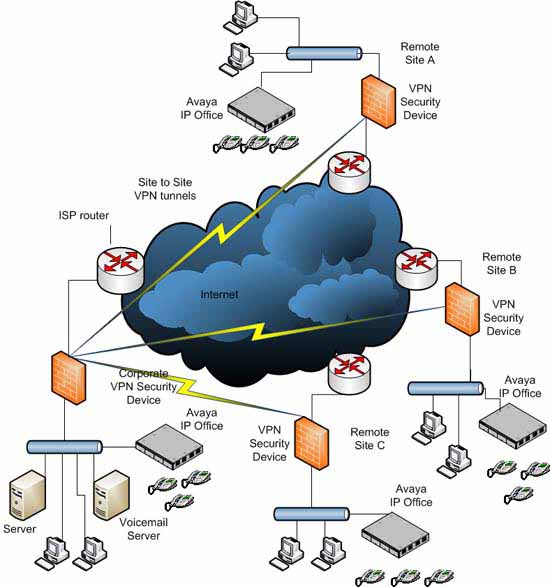
VPN
VPN
remote phones are a great success for those that need a phone at
home or small office remote locations. They could even be used on
the road where you spend a week at a client and need quick access
to workers, and them to you. While the benefits are nice, the problem
is often there are no guarantees for reliable connections and voice
quality can be unacceptable. These issues are inherent with non-managed
connections. With a managed connection, you will have a much greater
probability that the VPN phone will work satisfactory.
Unfortunately,
we find ourselves out at locations that a 'managed network' is not
offered. Reality is, that in most cases, we are forced to accept
the call quality that is presented. In the future, we believe
there will be better and more robust connections that will allow
for good, even excellent quality anywhere we go.
Avaya
Extreme Networks
ADTRAN
Engenius
Netgear
Sonicwall
Microsoft
Call us today to evaluate,
service, or quote your network.
847-781-9475
PRICING
PAGE
|
Copyright
2016 Bishop Computer Corporation
Microsoft is a registered trademark of Microsoft Corporation
in the United States and other countries.
Avaya,
Lucent, AT&T, IP Office, Definity, Partner, Merlin, Magix,
Intuity and Audix are registered trademarks of Avaya, Lucent
Technologies, and AT&T.
|
|